
LANKAVAMSA
Sri Lankan Historical Knowledge Graph
"A provenance-aware digital research infrastructure for exploring Sri Lanka's historical memory."
Connecting ancient chronicles, rock inscriptions, archaeological records, oral traditions, historical figures, locations, and contested events into an interconnected research environment.
Historical knowledge is fragmented.
Sri Lankan historical knowledge exists across Pali and Sinhala chronicles, thousands of Brahmi rock inscriptions, archaeological surveys, scholarly monographs, oral traditions, and localized folk memory.
Historically, these materials exist in silos. Traditional database models force flat, reconciled values (e.g., declaring a single absolute reign duration or character judgment), erasing the critical distinction between competing textual narratives.
When narratives diverge—such as conflicting chronicle perspectives on the character of King Elara or unverified battlefield locations—traditional systems either discard the divergence or present an arbitrary conclusion as definitive fact.
Lankavamsa is designed to connect these disparate materials while strictly preserving their source provenance, confidence ratings, and inherent historical uncertainties without unilateral reconciliation.
What Lankavamsa Connects
A multi-domain knowledge graph modeling history as an interconnected web of primary texts, physical evidence, oral memory, entities, and reified assertions.
Chronicles & Texts
Primary historical texts including the Mahāvamsa, Dīpavamsa, Cūlavamsa, Rājavaliya, and Pūjāvaliya.
Inscriptions & Epigraphy
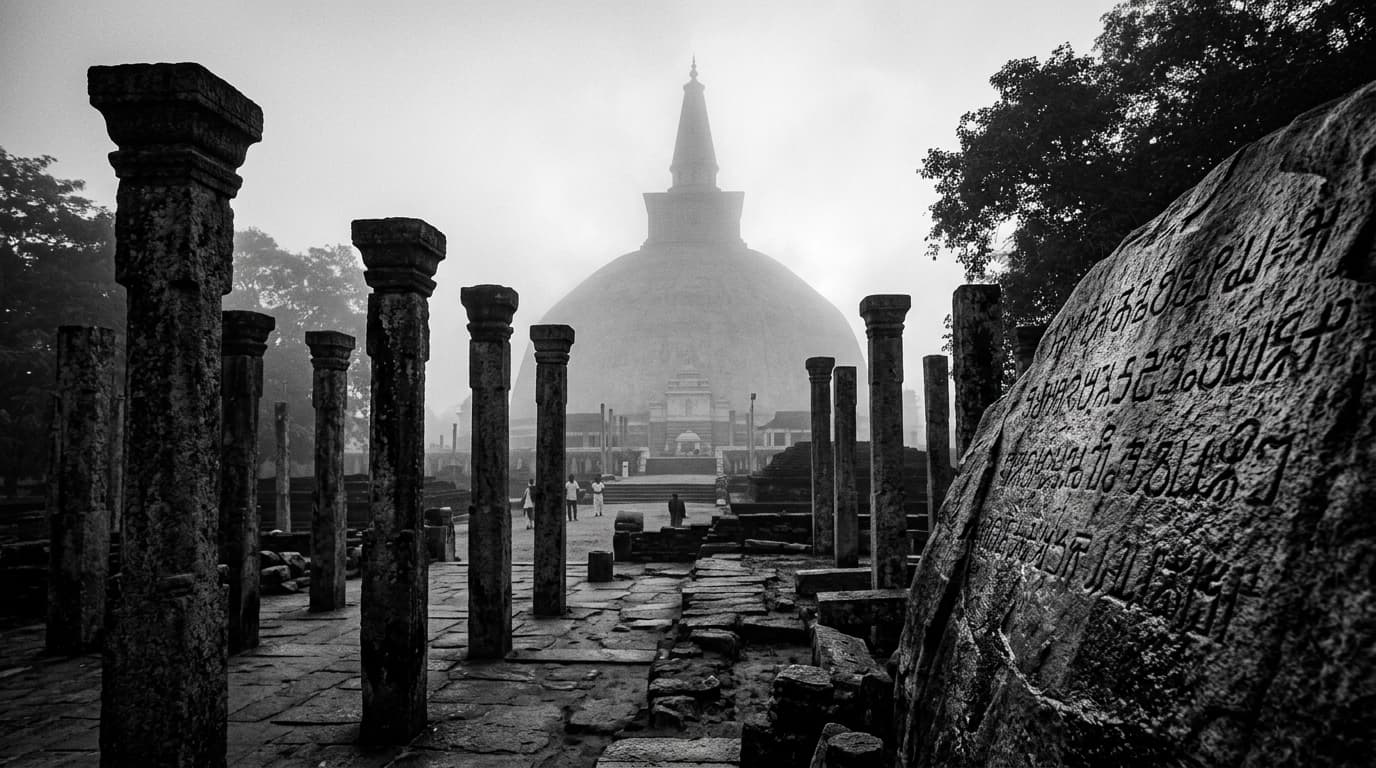
Brahmi rock edicts, cave donor inscriptions, slab records, and copper plates cataloging tangible epigraphical testimony.
Archaeological Evidence
Material artifacts, structural stratigraphy, carbon-dating chronologies, and verified archaeological site excavations.
Oral Traditions & Legends
Localized folk memory, regional legends, ballads, and folk traditions preserved in cultural communities across Sri Lanka.
Historical Figures
Monarchs, military commanders, religious elders, emissaries, lineages, and their recognized historical aliases.
Places & Topography
Ancient kingdoms, settlements, fortresses, monasteries, battlefields, river crossings, and geographic coordinates.
Events & Campaigns
Battles, military marches, coronations, treaties, diplomatic missions, and political transitions across historical eras.
Claims & Provenance
Reified relational assertions with explicit citation of chapters, folios, confidence ratings, and review audits.
The Core Research Model
Lankavamsa prevents the conflation of raw historical testimony with modern scholarly interpretation.
SOURCE
Documentary & Physical OriginWhat a historical work, lithic inscription, archaeological report, or oral recording contains in its original context.
EVIDENCE
Traceable Snippet / ObservationA specific passage, folio quotation, photographic record, translated fragment, or physical measurement.
CLAIM
Reified Assertion NodeA structured assertion connecting a Subject entity to an Object entity (e.g. Dutugemunu DEFEATED Elara) attributed directly to evidence.
INTERPRETATION
Historiographical SynthesisAn explanation developed by synthesizing multiple pieces of corroborating or conflicting evidence across different accounts.
HYPOTHESIS
Provisional Research ModelA tentative historical explanation or proposed reconstruction requiring further epigraphic and archaeological inquiry.
"These layers are deliberately kept separate."
A historical claim in Lankavamsa is never an immutable truth; it is a structured proposition grounded in traceable evidence. When accounts disagree, both claims persist side-by-side with full bibliographic attribution.
How Research Works
The systematic workflow for exploring historical questions and tracing claims across the knowledge graph.
1. QUESTION
Formulate a research inquiry regarding a historical event, figure's lineage, geographical movement, or contested reign.
2. DISCOVER
Locate relevant primary texts, stone inscriptions, archaeological surveys, and oral traditions referencing the entities.
3. CONNECT
Construct ontological graph relationships between figures, places, campaigns, and traditions with rule-governed validation.
4. COMPARE
Juxtapose corroborating, conflicting, and independent testimony across distinct textual and epigraphical traditions.
5. TRACE
Audit any relational claim back to its exact primary passage, folio translation, chapter, or inscription location.
6. INTERPRET
Develop and evaluate historiographical interpretations while explicitly preserving nuance and dissenting accounts.
Research Workspace (V1 Foundation)
The current V1 provides the foundational knowledge environment for constructing, auditing, and exploring the historical knowledge graph.
Historical Figures Registry
Biographical entities with alias indices, historical era bounds, and attached primary source citations.
Places & Topographical Nodes
Fortresses, monasteries, ancient settlements, and rivers linked to geographic locations and chronicle events.
Events & Historical Campaigns
Military battles, political treaties, and coronations cross-referenced with chronological approximations.
Oral Traditions & Folk Memory
Folklore and regional legends preserved with distinct evidence tags separate from formal chronicle texts.
Sources & Chronicles Catalog
Comprehensive bibliography of primary works, epigraphic corpora, and scholarly publications with bidirectional citation indices.
Historical Claims & Review Audits
Reified relational assertions categorized by evidence type, confidence rating, and audit status (Verified vs Disputed).
Cross-Entity Search Engine
Global search across figures, places, events, and textual assertions with category filters and instant suggestions.
Interactive Graph Exploration & Traversal
Multi-hop graph path exploration stepping through connected entities, claims, and supporting sources with persistent breadcrumb history.
The Dutugemunu–Elara Campaign
2nd Century BC Historical Stress Test for Provenance-Aware Knowledge Graph Modeling
Multi-Chronicle Divergence
The Mahāvamsa, Dīpavamsa, and Rājavaliya provide varying degrees of detail regarding King Elara's reign in Anuradhapura and King Dutugemunu's mobilization from Rohana.
Epigraphical & Spatial Routing
Correlating southern rock inscriptions and archaeological remains with chronicle claims of garrison strongholds (Mahiyangana, Kasatota, Vijithapura) along the Mahaweli river.
Contradiction Preservation
Chroniclers praised King Elara's legendary judicial fairness while simultaneously depicting his rule as foreign sovereignty—modeling both dimensions as attributable claims without distortion.
Dataset Case Study Available in Workspace
Explore entities, places, and asserted claims related to the Dutugemunu–Elara campaign inside the active V1 workspace.
Research & Development Roadmap
A phased research program expanding from the foundational graph ontology to document-grounded evidence pipelines and computational historical investigation.
Historical Research Foundation & Ontology
Core data models, reified claims, entity CRUD registries, Neo4j graph storage, and relationship constraints.
Document & Evidence Infrastructure
Direct processing of historical PDF texts into page-aware evidence passages, lithic inscription transcriptions, and passage-level graph linking.
Hybrid Historical Retrieval & Multilingual Indexing
Unified lexical and vector passage retrieval across Pali transliterations, Classical Sinhala texts, and English scholarly translations.
Cross-Source Convergence & Contradiction Engine
Automated visual mapping of historiographical consensus vs. isolated chronicle claims and archaeological refutations.